
Trump’s 2025 Tariff Policy: What It Means for Global Trade
I. A Bold Shift in U.S. Trade Strategy
In early 2025, the Trump administration launched a transformative trade policy that is reshaping how the United States engages with the global economy. On April 2, dubbed “Liberation Day”, President Trump unveiled a sweeping tariff plan, introducing a 10% tax on nearly all imports and additional targeted tariffs on countries accused of unfair trade practices. This move, one of the most significant trade policy shifts in decades, aims to protect American jobs, boost domestic industries, and challenge global trade dynamics.
However, the policy has sparked intense debate. While the administration touts it as a win for American workers and national security, critics - including economists and international partners - warn of rising consumer prices, disrupted supply chains, and a potential global recession. This article is a closer look at what the policy entails, how it impacts on the U.S. economy, and its broader implications for global trade.

Figure 1: Trump’s 2025 Tariff Policy Affected Global Trade(Source)
II. The Tariff Structure
The 2025 tariff plan is built on a two-tiered system, designed to make foreign goods more expensive and encourage domestic production:
• Universal 10% Tariff: Effective April 5, 2025, all goods imported into the United States face a baseline 10% tariff, a sharp increase from the previous average of 2.5%. The stated purpose of this universal tax is intended to increase the cost of foreign goods, thereby incentivizing domestic consumption and production.
• Reciprocal Tariffs: Layered on top of the baseline duty are additional "reciprocal tariffs", ranging from 11% to 50%, are applied to 57 countries identified as having “unfair” trade practices, such as large trade surpluses with the U.S. These higher rates were scheduled to take effect on April 9, but were suspended for 90 days for most targeted countries, except China.
The tariff impact varies by country:
• China: Faces an average tariff of 145%, a figure resulting from the combination of the new 10% baseline, specific reciprocal tariffs, and tariffs/penalties existing prior to 2025, effectively limiting many Chinese goods.
• European Union: Subject to a total tariff rate of 20%.
• Vietnam: Hit with a 46% tariff.
• Taiwan: Faced a 32% tariff.
• India: Faces a 27% tariff.
• Smaller Asian Economies: Other developing economies in Asia also faced steep rates, such as Bangladesh (37%) and Sri Lanka (44%), threatening their export-dependent industries.
These tariff disparities have fueled tensions among allies and trading partners, raising questions about the future of multilateral trade frameworks.
Between January and April 2025, the cumulative effect of these measures pushed the average U.S. tariff rate from a historic low of 2.5% to an estimated 27%, the highest in over a century. This tenfold increase underscores the policy's radical departure from the post-World War II trend towards trade liberalization.
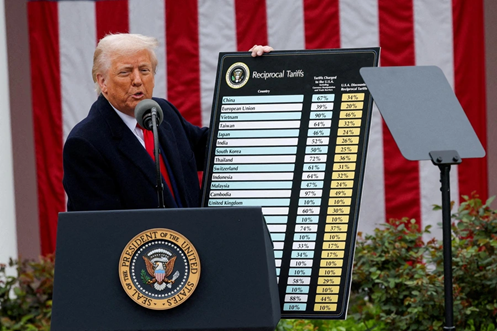
Figure 2: President Donald Trump delivers remarks on the reciprocal tariff policy in the Rose Garden on April 2, 2025. (Source)
However, some exemptions apply:
• North America: Goods compliant with the USMCA (United States-Mexico-Canada Agreement) remain duty-free. However, non-compliant items face a 25% tariff including steel, aluminum, and automobiles.
• Critical Industries: Sectors deemed vital for national security and economic stability -such as: pharmaceuticals, semiconductors, energy products, and lumber - are exempt to avoid disrupting essential supply chains.
• E-commerce: The duty-free exemption for low-value shipments (under $800) will end for China on May 2, 2025, with further changes planned for all countries later. This move targets a significant channel for cross-border e-commerce, particularly shipments from Chinese retailers.
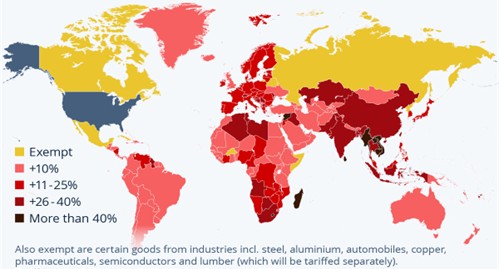
Figure 3: Additional tariffs imposed on countries under Trump's reciprocal regime announced April 2, 2025. (Source)
Table 1: Summary of Key U.S. Tariff Rates (Effective April 2025)
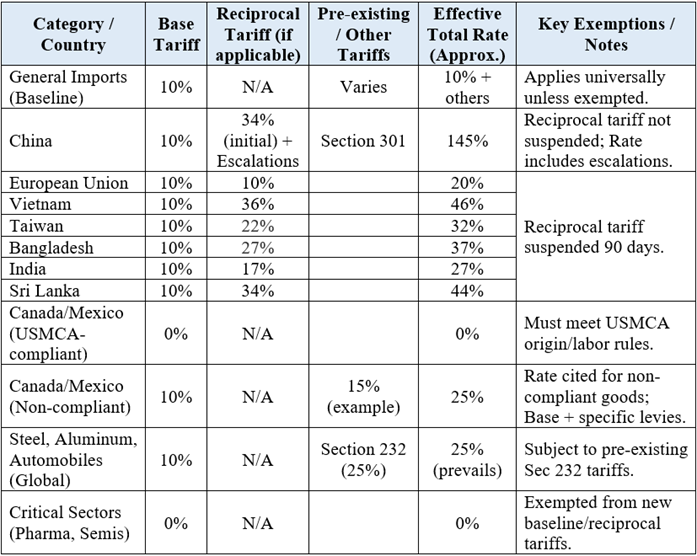
The resulting tariff structure is highly complex. It combines a universal baseline tariff, country-specific reciprocal rates, sector-specific exemptions, legacy tariffs from previous trade disputes, and special provisions under the USMCA for North America. This layered system poses significant challenges for government agencies and businesses alike - complicating compliance, increasing costs, and creating uncertainty across industries for both U.S. importers and foreign exporters.
With the structure and reach of the tariffs now established, the next question is: What does the United State administration hope to achieve with such sweeping measures?
III. Why These Tariffs? The Administration’s Case
The Trump administration frames this aggressive 2025 tariff policy as a core component of its “America First” agenda. According to the White House, these measures aim to achieve several key goals:
Revive U.S. Manufacturing: Tariffs are intended to make domestic production more competitive against foreign imports by raising the cost of imports, with the primary goal of bringing back U.S. factory jobs. The administration highlights a decline in America’s share of global manufacturing - from 28.4% in 2001 to 17.4% in 2023 - as justification for action.
Generate Revenue: The White House projects the tariffs will generate $5.2 trillion in revenue over ten years, which it claims can help reduce the substantial federal debt.
Reduce Dependence on China: By discouraging imports of Chinese goods, the policy aims to shift critical supply chains - particularly in technology and rare earth minerals - away from China Reducing U.S. reliance on Chinese supply chains.
• Ensure Fair Trade: The policy seeks to address “unfair” practices by countries seen as taking advantage of U.S. markets. The tariffs are seen as a means to “level the playing field” and force trading partners into renegotiation of trade terms.
• Strengthen National Security: Tariffs are also linked to border security objectives, including pressuring Mexico and Canada to address fentanyl trafficking and illegal immigration.
While these goals resonate with many supporters, critics argue they may conflict in practice. Protecting one industry could disrupt another, and many economists challenge the view that trade deficits inherently harm national economies.
IV. Impact on the U.S. Economy
The 2025 tariffs have already caused significant disruption across the U.S. economy, impacting production cost, pricing, growth prospects, and overall business confidence.
• Manufacturing Hurdles: Despite tariffs incentivize companies to relocate production domestically, the U.S. faces a shortage of over 500,000 skilled manufacturing workers. Rebuilding domestic supply chains is a complex and time-consuming process, often takes years and involves significant capital investment. Moreover, tariff on material like steel and aluminum (20%) can raise construction costs of building new factories and infrastructure needed for expanded domestic production. Additionally, China’s export restrictions on rare earth elements threaten critical high-tech manufacturing to U.S. industries. These materials are essential to electronics, renewable energy, and defense systems. Limited access risks bottlenecks in sectors the U.S. hopes to grow.
• Higher Consumer Prices: Tariffs act as a tax on imports, and companies are already passing costs on to consumers. Analysts estimate the average U.S. household will pay an extra $1,243 annually. Majors retailers such as Walmart and Target have issued warnings about unavoidable price increases in electronics, apparel, and household goods.
• Economic Slowdown Risks: Federal Reserve Chair Jerome Powell has described the situation as “challenging,” warning of stagflation - rising prices paired with slowing growth. Forecasts predict a 1% GDP drop, with some warning of a 10% plunge in Q2 2025. Over 60% of economists polled by Reuters see a global recession as “highly likely” within a year. In its March interim report, the Organisation for Economic Co-operation and Development (OECD) explicitly cited the new tariffs and heightened trade tensions as key reasons for downgrading U.S. GDP growth projections, forecasting growth slowing from 2.8% in 2024 to 2.2% in 2025 and further weakening to 1.6% in 2026.
• Business Uncertainty: The Federal Reserve noted unprecedented uncertainty, with businesses halting investments and hiring. Industry leaders, from Ford to the U.S. Chamber of Commerce, warn of “chaos” and a “massive tax increase.”
The speed and scale of the tariff implementation have overwhelmed typical economic adjustment mechanisms. The rapid jump to a 27% average effective tariff rate and punitive levels like 145% on Chinese goods is a major economic shock, risking short-term pain even if long-term gains are possible.
V. Global Ripple Effects
The tariffs are reshaping global trade, with significant consequences for U.S. partners and markets as: disrupting international supply chains, roiling financial markets, and casting a pall over global economic growth prospects.:
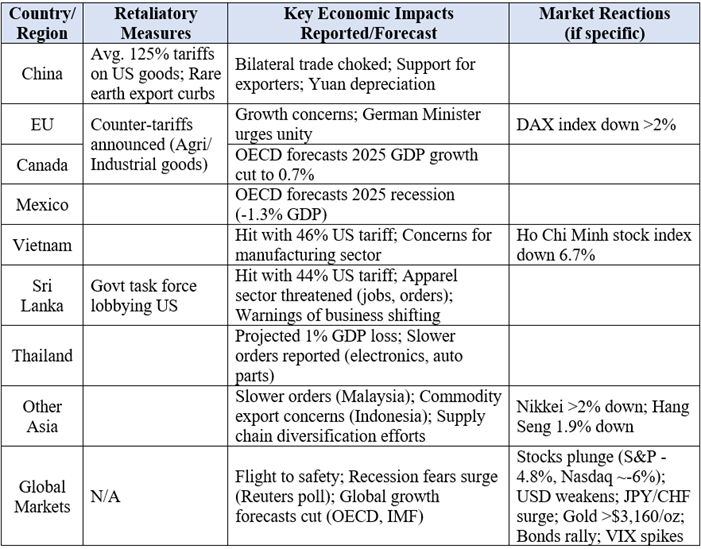
• Retaliation and Trade Wars: China responded with 125% tariffs on U.S. goods and imposed export restrictions on rare earths minerals and magnets - critical to global tech and defense industries. These moves escalated the conflict from a trade dispute to one of economic security and supply chain weaponization. The EU and Canada are planning counter-tariffs, targeting U.S. agriculture and industrial goods. The tit-for-tat escalation risks reducing global trade and increasing consumer costs worldwide.
• Economic Strain: Despite the protections offered by the USMCA, Canada’s GDP growth projection for 2025 was downgraded to 0.7%, while Mexico is forecast to faces a recession with a -1.3% GDP contraction. In Asia, Vietnam’s stock market dropped 6.7% following the tariff announcement. Thailand anticipates a potential 1% GDP loss, while Malaysia and Indonesia report slower demand in electronics and automotive exports. Sri Lanka’s apparel sector, hit with a 44% tariff, faces widespread job risk. Europe anticipates further economic headwinds as trade with the U.S. becomes costlier.
• Supply Chain Shifts: Multinational firms are urgently rethinking sourcing strategies. Companies are shifting production away from Asia, diversifying suppliers, and considering nearshoring options. However, restructuring global supply chains is both disruptive and expensive, often requiring years of logistical and infrastructure adaptation.
• Market Turmoil: Global markets reacted sharply to the April 2 announcement. The S&P 500 fell 4.8%, and the Nasdaq dropped 6% - the worst single-day performance since the COVID-19 pandemic in 2020. Major indices in Europe and Asia also posted 2–3% losses. Trillions of dollars in market value were erased. Global markets followed, with the U.S. dollar weakening as investors questioned U.S. stability. Investors rushed into traditional safe-haven assets. Gold hit $3,160 an ounce, and central banks signaled potential rate cuts. There was even discussion of potential coordinated action by G7 central banks if market instability intensified. This global policy response underscores the perceived severity of the economic threat posed by the U.S. tariffs.
Table 2: Global Reactions and Impacts Overview (April 2025)
VI. Legal and Political Context
The administration implemented these tariffs using emergency powers under the International Emergency Economic Powers Act (IEEPA), citing trade deficits as a “national emergency.” This approach has sparked controversy:
• Executive Authority: Critics argue that using emergency powers for trade policy oversteps the President’s authority, as Congress typically oversees trade.
• Democratic Concerns: Bypassing Congress raises questions about checks and balances, potentially setting a precedent for future unilateral actions.
This legal strategy underscores the policy’s boldness but also its divisiveness, challenging traditional governance norms.
VII. Looking Ahead
The Trump administration’s 2025 tariff policy is a high-stakes effort to prioritize American industry and sovereignty. It promises to revitalize manufacturing, generate revenue, and address global trade imbalances. Yet, the immediate fallout - higher costs, economic uncertainty, and global retaliation - suggests significant risks.
For businesses, navigating this new landscape means grappling with complex regulations, rising costs, and shifting supply chains. For consumers, it means tighter budgets as prices climb. Globally, the policy threatens to fracture trade relationships and weaken economic growth.
As we move forward, the success of this policy will depend on whether it can deliver on its ambitious goals without triggering a deeper economic downturn. The coming months will be pivotal, and businesses, policymakers, and consumers alike will be watching closely to see how this bold experiment unfolds.


