Surge of the Taiwanese Dollar in May and June 2025
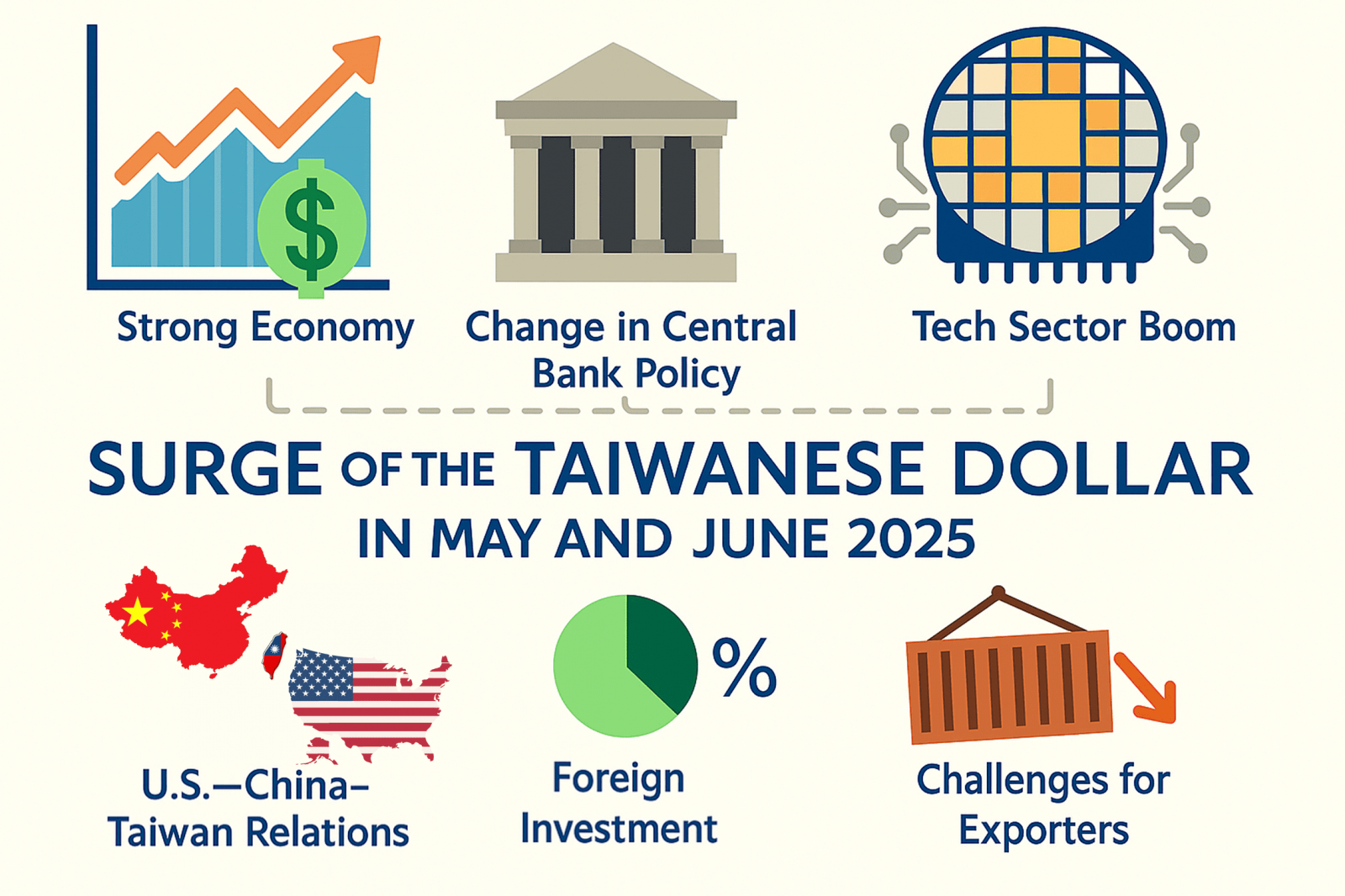
1. Overview
Between early May and mid-June 2025, the New Taiwan Dollar (TWD) experienced an unusually sharp appreciation against the U.S. dollar. In the first two trading days of May, TWD jumped roughly 6–8% versus the USD – its steepest two-day rise since 1988. A one-day rise of over 4–5% and a nearly 10% appreciation in a month are virtually unprecedented for major currencies, especially given that Taiwan's exchange rate is typically stable due to central bank management. The sudden surge sent the USD/TWD exchange rate down to approximately 30.14 TWD per USD, the strongest level for the TWD in over two years. Trading volume exploded to 15-year highs amid a flurry of speculative activity.
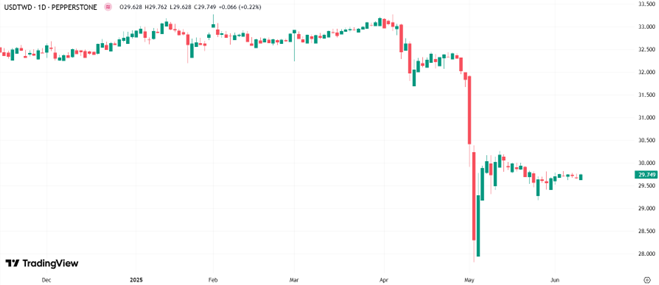
Figure 1: USD/TWD exchange rate chart showing the Taiwanese dollar’s sharp appreciation in May and June 2025. (Source: TradingView)
Multiple factors explain why the TWD surged so dramatically during May and June, 2025. Below, we break down each factor and how they contributed to the TWD’s rise, illuminated by data and expert commentary.
2. Strong Economic Fundamentals and Tech Sector Boom
Taiwan’s economy entered 2025 with healthy momentum, supporting the appreciation of TWD. Taiwan’s GDP grew by 5.37% year-on-year in Q1 2025, up from 4.59% growth rate in 2024, outperforming many regional peers. This robust output, particularly in high-value sectors, signaled that Taiwan’s economy could sustain a stronger currency without immediately hindering growth. This led the International Monetary Fund (IMF) to raise Taiwan’s 2025 growth forecast upward to 2.9% (from 2.7%), while downgrading projections for neighboring Asian economies like Hong Kong, South Korea, and Singapore.
Inflation also remains moderate, forecasted at 1.89% for 2025, giving policymakers flexibility to allow TWD appreciation without tightening monetary policy, as a stronger TWD could help lower import costs and keep inflation in check.
A major driver behind Taiwan’s economic strength was its booming technology sector, particularly semiconductors. Led by the world’s largest contract chipmaker TSMC, Taiwan benefited from strong global demand for semiconductor chips used in artificial intelligence (AI), 5G, and high-performance computing. Major clients such as NVIDIA placed large orders for AI-related semiconductors, contributing to Taiwan’s export strength and reinforcing its sizable trade surplus. In 2024, Taiwan recorded a US$73.7 billion goods surplus with the United States, largely driven by these high-tech exports. This export performance not only delivered substantial foreign exchange earnings but also supported growing investor confidence in the TWD.
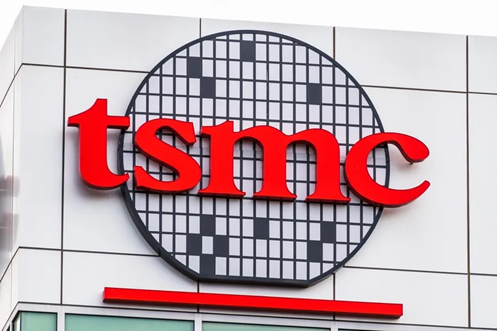
Figure 2: The world’s largest contract chipmaker TSMC (Source)
3. Central Bank Policy and Currency Management
Taiwan’s Central Bank (CBC) typically manages the TWD tightly to prevent wild swings, but its stance subtly shifted in May 2025. In late March 2025, the CBC kept its benchmark interest rate unchanged at 2.00%, citing lingering inflation concerns and uncertainty over U.S. trade tariffs. By keeping rates at 2% (and explicitly saying there were no grounds for cutting), Taiwan maintained a relatively higher yield compared to some neighboring countries such as the Philippines and Thailand, which had begun easing policy. This interest rate stance made Taiwanese assets more attractive to yield-seeking investors, especially as U.S. rates had peaked.
More notable, however, was the CBC’s approach to currency intervention during the TWD’s early-May rally. Normally, the CBC actively manages exchange rate stability by intervening in the foreign exchange market - often buying USD to slow TWD appreciation. However, during the major surges on May 2 and May 5, traders observed the absence of aggressive intervention to counteract the TWD’s rise. This relative inaction was widely interpreted as tacit official approval for a stronger currency.
This policy shift coincided with the first round of in-person U.S.–Taiwan trade negotiations in late April and early May 2025. These talks followed a surprise announcement by President Donald Trump on April 2 proposing 32% import tariff on Taiwanese goods, which was later suspended. Although the tariff threat initially rattled markets, the suspension and the launch of trade negotiations raised hopes of a diplomatic resolution. The TWD surged sharply after the negotiations leading many traders to suspect a behind-the-scenes agreement involving a currency component. This speculation gave rise to the theory of “Taiwan version of the Plaza Accord”, referencing the 1985 agreement in which countries agreed to strengthen their currencies versus the U.S. dollar. According to this view, Taiwan may have allowed its currency to strengthen in exchange for reduced trade friction or tariff concessions from the U.S., thereby reducing its trade surplus and demonstrate goodwill.

Figure 3: Taiwan–U.S. trade talks at Office of Trade Negotiations Executive Yuan (Source)
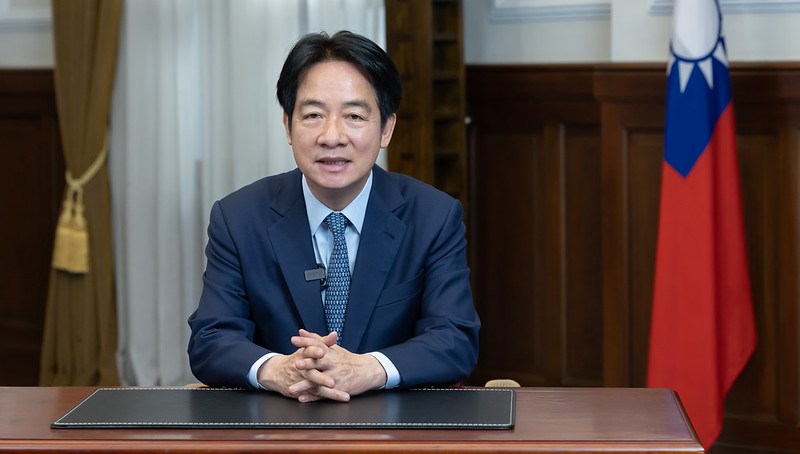
Both the CBC and government officials denied the existence of any such arrangement. In a May 5 emergency press briefing, the central bank attributed the TWD’s rise was driven by market forces and corporate expectations. President Lai Ching-Te also emphasized that Taiwan had never been labeled a currency manipulator by the U.S. and that its trade surplus reflects genuine global demand for Taiwan’s high-tech exports. Despite these denials, the Central Bank’s decision not to intervene during the TWD’s rapid appreciation was widely interpreted as a tacit signal to the market - whether to appease trade partners or to reflect Taiwan’s economic fundamentals.

Figure 4: President Lai Ching-te speaks at a press conference (Source)
4. Foreign Investment Trends and Capital Flows
A surge in capital inflows and the unwinding of past currency positions directly contributed to the TWD’s rise.
After a brief pullback in April due to U.S. tariff threats, foreign institutions returned to Taiwan’s equity market in force. By early May, foreign investors had resumed buying on the Taipei stock exchange. These equity inflows required converting foreign currency into TWD, increasing demand for the local currency. By mid-May, bullish bets on the TWD had surged to their highest level since 2020, as traders and funds raised long positions on expectations of further gains. Market participants describe a classic feedback loop: as the TWD started rising, various groups rushed to convert funds into TWD, which only intensified the currency’s climb. Indeed, foreign investor flows turned strongly positive, a sign of renewed confidence in Taiwan’s corporate earnings and stability.
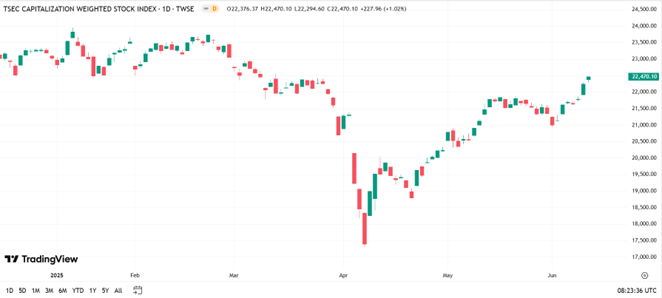
Figure 5: The Taiwan Stock Exchange's benchmark index (TAIEX), which had shaken below 18,000 points in April by tariff threats, rebounded above 22,000 by late May, reflecting renewed investor confidence and increased volatility. (Fuente: Tradingview)
At the same time, domestic exporters and institutional investors unwound huge USD positions, adding to the TWD buying pressure. Years of large trade surpluses meant Taiwanese exporters and life insurers had accumulated vast USD holdings on the expectation that the TWD would stay weak. When the dollar began to tumble, exporters saw their USD revenue losing value in TWD terms and rushed to convert their dollar receipts quickly into TWD to avoid further exchange losses. Meanwhile, Taiwan’s giant life insurance companies –holding an estimated US$700 billion in USD-denominated assets – was under-hedged. With only about 65% of these assets were hedged (a historic low level of hedging), so the remaining unhedged portion was directly exposed to currency losses, as the TWD rose. Fearing continued USD downturn, life insurers began rebalancing by selling USD and buying TWD to hedge exposure, further driving the TWD upward. Traders described a sense of “panic” as both exporters and insurers were rushing to exit their USD positions, intensifying upward pressure on the currency.
A third catalyst was the unwinding of TWD carry trades. For years, global investors had borrowed TWD at low interest rates to fund investments in higher-yield assets elsewhere - a strategy that worked as long as the currency remained stable. But as the TWD began to surge, these trades turned unprofitable. Foreign investors rushed to cover short TWD exposures by buying back the currency, adding to the buying pressure and accelerating the rally. One strategist noted that Taiwanese investors diversifying away from U.S. assets and hedging dollars aligned with a growing sentiment that the dollar’s strongest days might be over.
5. Geopolitical Factors: U.S.–China–Taiwan Relations
Taiwan’s strategic role as a key supplier to both the U.S. and China further amplified its currency's significance. With Washington pursuing re-shoring policies and targeting trade imbalances, currencies of surplus countries like Taiwan faced upward pressure. The TWD’s rise thus reflected not only local economic strength but also deeper realignments in global trade and capital flows - placing Taiwan squarely at the center of evolving U.S.- China economic tensions.
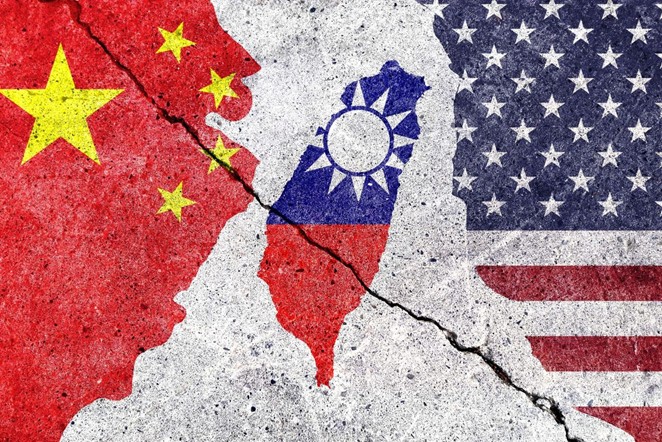
Figure 6: Taiwan’s strategic position amid U.S.–China conflict (Source)
6. Double-Edged Sword: Challenges for Exporters and Aquasky
A stronger TWD is a double-edged sword for the economy. On one hand, it signals global confidence in Taiwan. On the other, it places pricing pressure on the export-heavy tech sector, especially if the TWD remains elevated for an extended period. Taiwanese goods become relatively more expensive in global markets, and companies that earn revenue in U.S. dollars - such as chip exporters - see their revenues shrink when converted back to TWD. A sudden 5–10% move in exchange rates can significantly hurt profit margins for overseas sales.
Taiwan’s government has acknowledged these concerns, advising that the impact will vary across industries and urging the public to remain confident in the overall economy. In the short run, investor optimism remained high, but a prolonged TWD surge could pose challenges for Taiwan’s export competitiveness if rivals benefit from weaker currencies.
At Aquasky, a leading Taiwanese manufacturer of high-pressure water tanks, we are closely monitoring the implications of the TWD’s appreciation. The currency's strength has the potential to reduce the NT-dollar value of our USD-denominated export revenues and affect pricing flexibility in international markets. However, Aquasky remains confident that our innovation, international diversification, and risk management approach will protect competitiveness. Aquasky views this currency shift not just as a challenge, but as an opportunity to enhance our resilience and further evolve our global strategy.
7. Conclusion
The dramatic appreciation of the New Taiwan Dollar in May and June 2025 marked one of the most significant currency movements in Taiwan’s financial history. Driven by a combination of strong economic fundamentals, booming tech exports, foreign capital inflows, and a subtle shift in central bank posture, the TWD’s rise reflected deep confidence in Taiwan’s economic resilience and global relevance.
While the appreciation has brought positive recognition - showcasing Taiwan as a high-performing, tech-driven economy - it also introduced real challenges for exporters and manufacturers dependent on USD-denominated revenues. For manufacturers like Aquasky, this appreciation serves as both a challenge and a catalyst. A stronger TWD compresses export margins and heightens pricing pressures abroad, but it also reinforces the importance of financial discipline, market diversification, and innovation. Taiwan’s economic strength remains an asset, but adapting to currency volatility will be critical for maintaining long-term competitiveness.
Looking ahead, the sustainability of the stronger TWD will depend on several variables: the global demand for semiconductors and tech exports, evolving U.S.-China-Taiwan relations, and whether Taiwan’s central bank resumes active intervention should volatility spike again.
For businesses, this moment underscores the importance of active foreign exchange risk management. While Taiwan’s economy remains robust, exporters must prepare for the possibility that a strong TWD is not just a temporary anomaly - but a reflection of Taiwan’s elevated role in the global economy.
In this environment, Aquasky is committed to navigating volatility with confidence - transforming risk into opportunity, and strengthening global role in water system solutions.