
With the explosive growth of Artificial Intelligence (AI), High-Performance Computing (HPC), and the Internet of Things, the Thermal Design Power (TDP) per individual rack in data centers is rapidly surging past 100 kw. Traditional air-cooling technologies have hit their physical limits. Consequently, Direct Liquid Cooling (DLC) or Direct-to-Chip liquid cooling architectures, centered around the Coolant Distribution Unit (CDU), have become the standard deployment configuration for major Hyperscalers (such as Google, Microsoft, and Amazon).
Within these highly complex and precision-engineered fluid piping systems, maintaining micro-pressure stability, absorbing thermal expansion caused by severe temperature fluctuations, and preventing coolant leakage and system cavitation are paramount to ensuring 24/7/365 uninterrupted server operations. This white paper explores the core physical mechanisms of expansion tanks within the secondary loop, and elucidates the technical advantages of AQUASKY’s All-Stainless Steel Diaphragm Expansion Tanks, engineered explicitly for extreme liquid cooling operating conditions.
%20(1).png)
I. Why Must Liquid-Cold CDU Systems Be Configured with "Expansion Tanks"?
The coolant distribution unit (CDU) serves as the central hub for heat exchange and fluid control within data center liquid cooling architectures. The system is typically divided into a primary loop (externally connected to cooling towers or chillers) and a secondary loop (directly circulating through the server Cold Plates). Within the enclosed secondary loop, fluid dynamics and thermodynamic characteristics dictate the mandatory integration of sealed expansion tanks:
1. Thermal Expansion Absorption
Under varying server computing loads, the water temperature experiences rapid and drastic fluctuations. As the temperature of the cooling medium (such as deionized pure water or a 25% Propylene Glycol solution - PG25) rises, its fluid density decreases, resulting in volume expansion.
Because the piping network and cold plates are completely rigid, if there is no flexible tank to absorb this expanded volume, the incompressibility of the fluid will cause the internal system pressure to spike exponentially. This micro-expansion can easily trigger cold plate deformation, quick disconnect (QD) leaks, or catastrophic pipe ruptures, leading to devastating server failure.
2. Dynamic Pressure Compensation & Cavitation Prevention
Conversely, when server workloads abruptly drop, the coolant cools and contracts. Without systematic compensation, a localized negative pressure (vacuum state) is instantaneously generated within the loop.
This negative pressure not only draws external air into the system through microscopic seal pores—leading to piping oxidation—but also triggers cavitation at the inlet side of the circulation pump. As vapor bubbles collapse at high frequencies, the pump impellers suffer rapid fatigue, generating excessive noise and risking pump burnout or sudden flow rate degradation. The expansion tank provides dynamic positive gauge pressure compensation, ensuring the system maintains a stable positive pressure regardless of temperature variations.
II. AQUASKY All-Stainless Steel Design: Directly Meeting Rigorous Hyperscaler Specifications
For elite end-users like Google, Microsoft, and Amazon AWS, the operational standard for data centers is "Zero Single Point of Failure". Traditional carbon steel expansion tanks with standard industrial coatings—widely used in residential HVAC or light industrial applications—completely fail to pass the stringent technical audits (LQC/TQR standards) required by these Hyperscalers.
Addressing this critical pain point, AQUASKY engineered an All-Stainless Steel design, delivering three core technical advantages:
1. Zero Corrosion & High-Purity Water Quality Maintenance
The fluid media utilized in the secondary loops of data centers (such as deionized water or specialized engineering coolants) are highly sensitive and corrosive toward standard metals.
Premium Material Selection: AQUASKY’s tank shells are fabricated utilizing high-grade stainless steel (SUS304 / SUS316L). Prior to factory dispatch, the surfaces undergo precise chemical passivation or electropolishing treatments. This effectively blocks any electrochemical reaction with the fluid medium, completely eliminating the risks of rusting or micro-particle shedding.
Protection of Precision Components: This absolute purity ensures that the intricate micro-channels within the cold plates remain unclogged by rust flakes or impurities, maintaining optimal thermal resistance.
2. Extreme Leak-Proof Structure & High Design Pressure Resilience
Precision Welding Craftsmanship: AQUASKY utilizes a proprietary, fully automated full-welding structure. Compared to traditional flange connections or threaded seals, the full-welding process eliminates the risk of gasket degradation caused by aging, thermal expansion, or contraction. This ensures absolute gas-tightness and liquid-tightness under an ultra-high design pressure capability exceeding 30 Bar, while keeping the Maximum Working Pressure (MWP) rated at 10 Bar.
Pressure Resilience: The stainless steel body possesses exceptionally high mechanical tensile strength. After undergoing countless pressure and thermal cycles, the tank shell remains immune to structural fatigue, deformation, or mechanical creep.
III. Specially Formulated EPDM Rubber Diaphragm: Perfect Physical Compatibility with PG25
The core component of an expansion tank lies in its flexible diaphragm, which completely isolates the water chamber from the air chamber. In collaboration with international polymer material laboratories, AQUASKY developed a proprietary Peroxide Cured EPDM diaphragm specifically optimized for data center liquid cooling systems:
1. Perfect Compatibility with PG25 (25% Propylene Glycol)
To prevent freezing at low temperatures and provide anti-corrosion protection, CDU secondary loops widely utilize a 25% Propylene Glycol water solution (PG25). Conventional rubbers (such as natural rubber or Nitrile NBR) suffer from swelling, hardening, and molecular degradation when exposed long-term to alcohols, additives, and corrosion inhibitors.
Chemical Resistance: AQUASKY’s Peroxide Cured EPDM diaphragm possesses extraordinarily stable chemical bonding, exhibiting near-zero chemical reactivity with PG25. Even during long-term high-temperature operations, the diaphragm does not leach plasticizers or precipitate impurities, ensuring the coolant's conductivity and chemical composition remain completely constant.
2. Superior Elastic Memory & Anti-Permeation
Microscopic Permeation Barrier: This specialized EPDM features an extremely low gas permeation rate, preventing gas molecules in the air chamber from diffusing at a molecular level into the coolant, thereby avoiding vapor locks in the secondary loop.
Anti-Fatigue Performance: During continuous, reciprocal deformations caused by severe temperature fluctuations, the diaphragm demonstrates exceptional elastic memory. It easily withstands high-frequency, wide-range expansions and contractions, guaranteeing a prolonged operational lifespan.
IV. Thermodynamic and Physical Advantages of Factory High-Purity Dry Nitrogen Pre-charge
The air chamber of AQUASKY’s sealed expansion tanks is pre-charged at the factory with high-purity dry nitrogen N2. Compared to conventional compressed air, pre-charging with nitrogen provides decisive thermodynamic and chemical protection advantages:
1. Eliminating Pressure Disruption from External/Internal Temperature Differences
Thermodynamic Stability: Nitrogen is an inert gas with a relatively large molecular volume and zero moisture content. Under extreme ambient temperature fluctuations, its expansion x`coefficient remains extremely low and stable, strictly adhering to the Ideal Gas Law:
P⋅V=n⋅R⋅T
Constant Pressure Control: Consequently, even if the surrounding data center white space or server rack ambient temperatures fluctuate wildly, the factory pre-charge pressure (P_"Pre" ) within the tank maintains astonishing consistency. It prevents any pressure drift caused by moisture condensation or thermal expansion of ambient air, ensuring the control logic of the CDU’s pressure control components (such as pressure transmitters and safety relief valves) remains undisturbed.
2. Preventing Internal Oxidation and Diaphragm Aging
Long Lifespan Guarantee: If conventional compressed air is used, the oxygen and moisture content under continuous pressure and medium-to-high temperatures will cause microscopic oxidation and hydrolysis on the back side of the diaphragm, accelerating rubber aging and cracking. The high-purity dry nitrogen creates a completely oxygen-free, moisture-free inert environment. This fundamentally eliminates any gas-phase corrosion against the diaphragm material and the internal stainless steel walls, extending the tank’s design life to over 10 years - perfectly aligning with the lifecycle of the data center.
V. Technical Parameters & Physical Performance Comparison Matrix
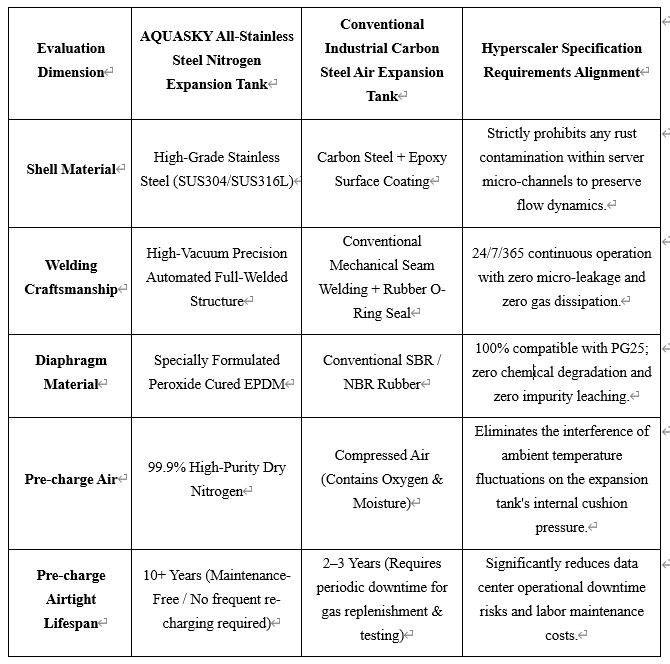
VI. Conclusion
In today's Hyperscale data centers, where Power Usage Effectiveness (PUE) is driven to the absolute physical limit, even a minuscule failure in the liquid cooling architecture can result in millions of dollars in lost computing capacity. The ultimate stability of the Coolant Distribution Unit (CDU) depends entirely upon the absolute reliability of every underlying physical component.
By engineering an all-stainless steel tank shell design, paired with a high-purity dry nitrogen factory pre-charge and a peroxide-cured EPDM diaphragm perfectly compatible with PG25, AQUASKY delivers the ultimate engineering solution for handling high temperature differentials and severe pressure fluctuations. This architecture not only satisfies the rigid "Zero-Corrosion, Zero-Leakage, Supreme Reliability" hardware demands of top-tier cloud providers like Google, Microsoft, and Amazon, but also fortifies the most solid line of defense for high-performance cooling infrastructures in the AI computing era.